A Rehearsal Plan for a Song That Keeps Losing Its Ending
A rehearsal plan for a song that keeps losing its ending helps a band agree on one clear cue, compare endings calmly and leave with a shared arrangement.
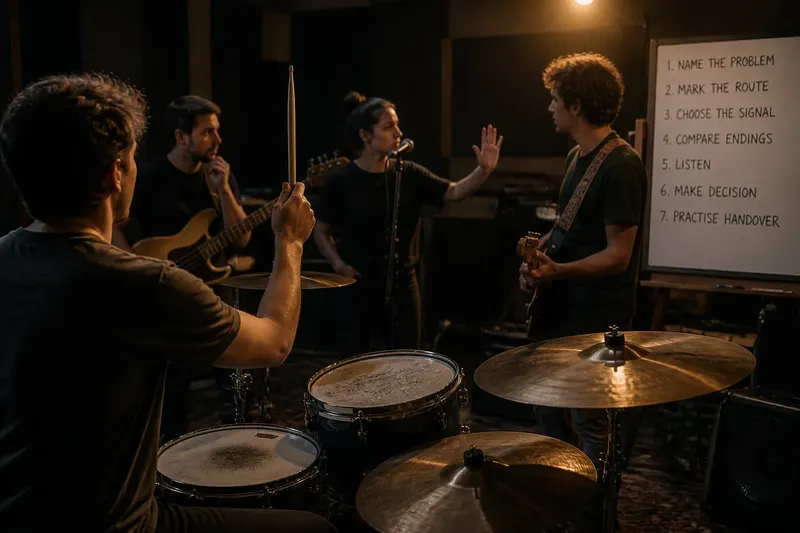
The drummer lets the last chorus roll, the guitarist adds a flourish, and the singer is already reaching for the microphone stand when the bass player plays one more bar. A rehearsal plan for a song that keeps losing its ending begins by treating that muddle as a specific arrangement problem: the band needs one cue, one response and one agreed final sound.
Set aside a focused part of rehearsal for the ending alone. The aim is not to generate a catalogue of dramatic finishes. It is to make a few deliberate choices, hear them in context and leave with a version every player can recognise and repeat.
1. Name the problem
Before picking an ending, describe what currently goes wrong in plain musical terms. Does the band keep playing because nobody knows the last bar? Does the singer signal a stop that the drummer cannot see? Is there a final chord, but no agreement about whether it rings or is cut short?
Ask each player for one concise observation. Keep the discussion about what can be heard or seen, not who caused the confusion. “The vocal line ends before the final chord” gives the band something to solve; “you always rush the finish” invites an argument about blame.
Write the problem on a board or a piece of paper, then choose the one that matters most. If the band is uncertain about both the cue and the chord, settle the cue first. Several ambiguities can coexist, but trying to repair all of them in the same first pass makes it harder to tell what has improved.
2. Mark the current route
Play the song as it is usually performed, without changing the ending to make a point. The person who is best placed to hear the ensemble can note the route from the last chorus to silence: how many bars remain, what the singer does, where the rhythm section changes, and when the sound actually stops.
Use a familiar reference such as the lyric sheet, a chord chart or a whiteboard. Mark the final section with simple words: “last chorus”, “cue”, “final hit”, “ring”. This need not become a full transcription. Its purpose is to give everyone the same landmarks and expose any mismatch between what people think happens and what they are playing.
If one player believes the band repeats the last line while another expects an immediate chord, make that disagreement explicit. A shared ending cannot be built on different mental maps. Agree on the current route before discussing alternatives, even if the current route is the very thing that keeps falling apart.
3. Choose the signal
A final cue should be easy for the whole group to recognise while playing. It might be a sung word, a breath, a raised instrument, a clear drum fill or a change in the harmony. The best choice depends on the song and the people onstage; a visual signal is of little use to someone who cannot see it, while a subtle vocal breath may disappear in a loud arrangement.
Decide who gives the cue and who follows it. Naming one cue-giver prevents a chorus of competing gestures. The rest of the band should know which event counts: for example, the singer’s final word, rather than the guitarist’s flourish that happens just before it.
Make the signal distinct from ordinary playing. If the drummer uses a fill elsewhere in the song, that fill alone may not say “ending”. Pair it with a clear visual gesture or place it only at the final transition. The cue should identify the moment to act, not require players to guess what the leader meant.
4. Compare three endings
Limit the choice to a small set of contrasting options. Too many variations turn a rehearsal into an open-ended audition, and minor changes are hard to compare while the band is still learning the basic cue. Choose endings that differ in a way listeners and players can plainly hear.
- Held chord: everyone lands together and lets the harmony ring until the sound naturally fades.
- Cut-off chord: the band lands together, then stops the sound on a shared signal.
- Short tag: the band repeats a brief phrase or the final lyric, then lands on a decisive chord.
For each version, state the route before playing it: “last chorus, final line, one chord, cut off”. A short verbal count-in can help the first attempt, but the final arrangement should work without explanatory chatter. Try each option once or twice, keeping the rest of the song unchanged so that the ending itself remains the point of comparison.
5. Listen for the right things
After each attempt, ask questions that describe the performance rather than declare a winner. Did everyone hear the cue? Did the final chord land together? Did the singer have enough space to finish the phrase? Could the band tell when the sound was meant to stop?
Let players answer in turn, and keep comments specific. “The bass entered after the final word” can lead to a clear adjustment. “That felt weak” needs a follow-up: was the cue unclear, was the chord too soft, or did the ending simply lack the character the song needs?
Consider the song’s character as well as its neatness. A held chord can suit a reflective lyric, while a firm cut-off may give a punchier arrangement a clean edge. A tag can make the final line memorable, but it also asks the singer and band to coordinate another phrase. Choose for the song, not for the most theatrical finish in isolation.
6. Make one arrangement decision
Once the group has heard the options, choose one version to adopt for now. A decision is more useful than a vague preference such as “let’s keep it loose”. Write down the parts that make the ending repeatable: the cue-giver, the cue itself, the final musical action and whether the sound rings or stops.
Say you are rehearsing a song whose last lyric ends over a busy drum pattern. Imagine the group chooses a short tag: the singer repeats the final phrase, lifts a hand on its last word, and everyone lands on a chord that is cut off together. The expected observable result is that the players can identify the signal, arrive at the same final chord and stop at the agreed moment. If any of those events remains unclear, revise that part rather than reopening every choice.
Write the decision where the band can find it: on the chord chart, in a shared rehearsal note or beside the final lyric on the set list. Use ordinary language, not a mark only one player understands. The note should capture the arrangement, not every comment made while choosing it.
7. Practise the handover
Run the transition into the ending from a useful point, such as the start of the last chorus. Repeating only the final chord may make the landing tidy while leaving the real difficulty untouched: a cue can be clear in isolation and still vanish beneath a full arrangement.
On the first run, the cue-giver should perform the signal as naturally as possible. The other players should respond without waiting for a spoken count. If the ending works only after someone announces “now”, the group has not yet established a musical cue that can survive performance.
Then play the whole song once, without stopping to correct small imperfections. Note whether the ending remains recognisable after the band has moved through the full arrangement. If it falls apart, identify the first point of uncertainty and rehearse that handover again. Avoid restarting from the top each time; it consumes attention without giving the group more practice at the troublesome moment.
8. Record the shared version
At the end of the session, confirm the decision aloud and give each player a chance to say what they understand it to be. This is a quick check for differences in interpretation, not a new vote. One person may hear “cut off” as a short decay, while another expects the sound to stop sharply; the band should clarify that distinction before it becomes a disagreement onstage.
Keep a simple note on the chart, such as: “Last chorus; singer raises hand on final word; tag once; all land together; cut off on the singer’s nod.” Adjust the words to describe what the players actually agreed. If the arrangement depends on a drummer’s fill or a guitarist’s chord change, include it only when it is part of the cue rather than an incidental flourish.
Keep the note brief enough to scan at a glance. Rehearsal records can become cluttered with abandoned ideas, alternate endings and commentary about what went wrong. Move those out of the active chart, leaving one current version where the band will look just before playing.
9. Revisit only with a reason
A settled ending need not be permanent, but it should remain stable long enough for the ensemble to build confidence in it. Reopen the decision if a meaningful change gives the band new information: the singer alters the phrasing, the arrangement gains an instrument, or the ending proves hard to cue in the room where the group performs.
Do not keep changing the finish because a new idea appears every time someone listens to a recording. A little variety can be useful in the choosing stage; after the band has selected its version, constant revisions make it difficult to know whether the shared arrangement is actually becoming familiar. That is not worth the effort unless the new option solves a concrete problem or better serves the song.
When the ending is stable, the rehearsal plan has done its job: everyone knows who signals, what the group does next and how the sound ends. A rehearsal plan for a song that keeps losing its ending is most useful when it leaves behind one clear decision, simple enough to remember and precise enough to play together.