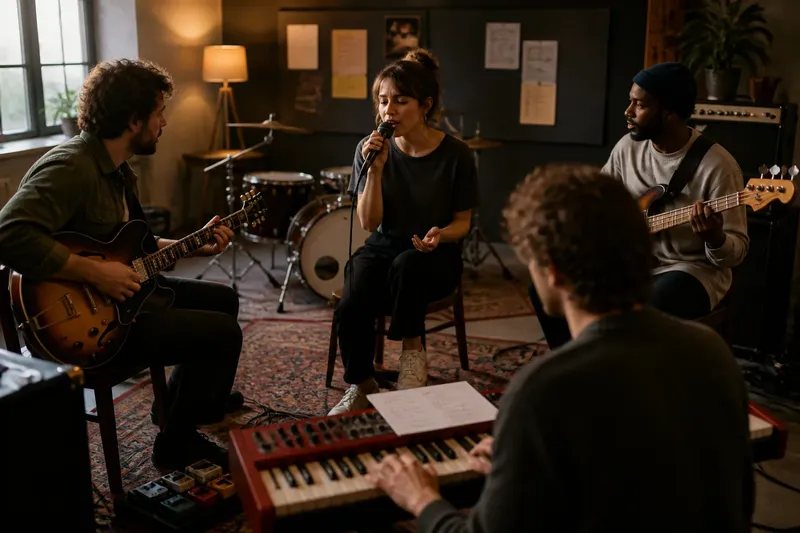
A Groove Needs More Than a Steady Beat
A groove grows from repeated accents and contrasting rhythms. Learn a focused listening exercise to hear where the pulse seems to lean.
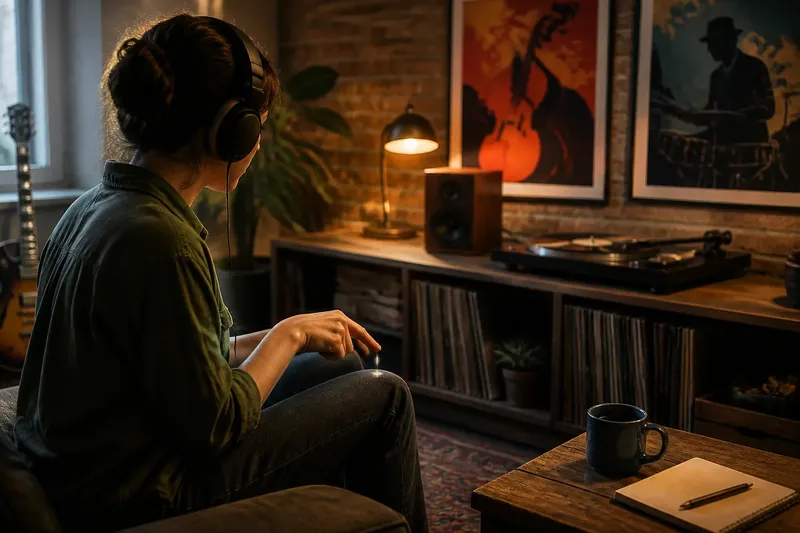
Put on a song you know and tap evenly on your knee. The beat may be steady, yet the music can still seem to push forward, settle back or sway around your tapping. A groove comes from that relationship: repeated accents give the ear something to expect, while contrasting rhythms make the expectation feel alive.
You can hear this without knowing musical notation or owning an instrument. The useful task is not to count faster, but to notice which sounds return, which sounds answer them, and where your sense of the pulse seems to lean. Try the listening exercise below, then carry the same attention to your own playing.
Choose a clear recording
Begin with a track whose beat is easy to follow and whose parts are distinct. A spare drum pattern, a bass line with a clear attack, or a hand-played rhythm can work well. If a dense mix makes it difficult to separate sounds, choose another track; the aim is to hear relationships, not to solve the whole arrangement.
Listen once without tapping. Notice the broad character of the motion: does it feel settled, loping, urgent, buoyant, or restrained? These words are not labels you have to get right. They simply give you a first impression to compare with what you hear more carefully.
Now tap a comfortable, even pulse. Keep the movement small, such as a fingertip against your thigh. Do not try to match every drum hit. Your tap is a reference line, a way to notice how the other sounds sit around a recurring beat.
Separate pulse from accents
The pulse is the regular underlying beat you can tap through the music. An accent is a sound that attracts extra attention: it may be louder, sharper, lower in pitch, or placed in a way that makes it stand out. Accents can land directly on the pulse or between its beats. Either way, they shape how the beat feels.
Keep tapping evenly and listen for a sound that returns with some regularity. It might be a kick drum, a bass note, a guitar attack, or a clap. Follow just that sound for a few moments. Does it coincide with every tap, with alternate taps, or with a point between them?
Then listen for a second recurring sound. A snare or handclap might answer the bass drum; a shaker might fill the spaces left open by both. The important feature is not the instrument name but the pattern of return. One repeated accent can make a pulse feel grounded, while another placed elsewhere can create lift, drag or a gentle lilt.
Try not to treat every prominent sound as the beat. A sharp note can pull your attention towards itself without replacing the underlying pulse. If your tapping starts to follow each flourish, return to a simple, steady movement and let the sound pass across it.
Hear contrasting patterns
A groove often gains character because its parts do not all repeat the same rhythm. The bass may make a few widely spaced notes while a shaker marks smaller subdivisions. A drum hit may recur in one place, with a guitar phrase answering in another. Their contrast creates a pattern of expectation and response.
Listen for the spaces as carefully as the sounds. If a part leaves room before repeating, the next attack may seem to arrive with particular weight. If another part keeps moving through that gap, the music can feel more continuous without making the main pulse less clear.
Notice what happens when two accents coincide. The combined sound may feel firmer than either part alone. When they separate, the same underlying pulse can feel more elastic. Neither effect requires the beat to speed up or slow down; the change comes from where the recurring sounds meet.
Say you hear a low note returning on your first tap and a light click landing between taps. Keep the tap steady, then hum the low notes and click the offbeat quietly with your voice. The expected result is that the low notes feel like anchors while the clicks seem to tug the phrase forward, even though your pulse has not changed.
Try the leaning-pulse exercise
Use a short section of the recording, such as a verse or a repeated instrumental figure. You do not need to identify every subdivision. Move through these actions in order, stopping when the texture changes enough that the pattern is no longer clear.
Set a quiet pulse. Tap evenly through the section, using a small movement. Choose a pace that feels comfortable rather than trying to match a particular instrument.
Follow one anchor. Pick the most consistent low or weighty sound you can hear. Keep your tap going while you listen for the places where that sound returns.
Find a contrasting sound. Listen for a lighter, sharper or more frequent part. Notice whether it falls with the anchor, between its returns, or in a changing pattern.
Let your body respond. Without changing the tap, notice whether your shoulders, head or voice seem to anticipate a particular accent. That anticipation can reveal where the groove appears to lean.
Change your reference. Stop following the anchor and listen to the contrasting part instead. Keep the same pulse and ask whether the music now feels as settled, or whether its motion seems to shift.
Check the effect. Listen once more without tapping. See whether you can still hear the anchor and the contrasting pattern as separate layers, and whether the same point in the phrase continues to draw your attention.
The exercise is about perception, not a right answer. Two listeners may feel the same pattern leaning in different ways, especially when the accents are subtle. What matters is being able to connect that sensation to something audible: a recurring emphasis, an offbeat, or a part that fills the spaces around another.
Bring the pattern to an instrument
Once the pattern is clear in your ear, try a simple version on an instrument. On a guitar, mute the strings and make soft downstrokes on the pulse while adding a lighter upstroke between selected beats. On a keyboard, hold back from playing full chords and use a short note or chord fragment to mark the contrasting rhythm. On a drum or hand percussion, keep one sound steady and place another in the gaps.
Start with fewer events than you think you need. If every subdivision is filled, the contrast between anchor and response can disappear. A part that leaves a clear space may make the next accent easier to hear and give another player room to add a different pattern.
Keep the sound modest while you are learning the relationship. A muted guitar, a soft shaker or a single piano note can make placement easier to judge than a loud, full arrangement. Change one thing at a time: move an accent, omit a note, or shift from a sustained sound to a short one, then listen for how the groove’s character changes.
Questions about groove?
Can a groove exist without drums?
Yes. Repeated notes, chord attacks, vocal phrasing or a handclap can establish accents and make a pulse feel shaped. Drums are one possible source of rhythmic emphasis, not a requirement.
Does a leaning pulse mean the tempo changes?
Not necessarily. A regular pulse can remain steady while accents on or between its beats alter the feeling of forward motion. Keep tapping evenly to separate that sensation from an actual change in pace.
What if I cannot hear the separate parts?
Choose a sparser passage or listen at a comfortable volume through speakers or headphones that let you hear the mix clearly. Focus on one recurring sound at a time rather than trying to name every instrument.
Should I copy the exact rhythm I hear?
Not at first. Try clapping or humming the broad pattern, then simplify it until you can keep it alongside the pulse. Exact imitation can wait until you can hear which accents make the pattern distinctive.
Keep only useful details
After listening, jot down a few plain observations: which sound anchored the pulse, which sound contrasted with it, and where the music seemed to lean. These notes are more useful than a string of guessed time signatures if your aim is to play the feel rather than analyse the score.
It is not worth the effort to label every hit or force the groove into a single adjective. Those tasks can draw attention away from the repeated relationship that makes the music move. Return to the recording, keep a steady tap, and see whether the same accents still stand out.
A groove needs more than a steady beat because the beat is only the reference; repeated accents and contrasting patterns give it direction and character. The next time you practise, listen for the sound that anchors the pulse and the sound that quietly resists it. That small distinction can guide where you place your own notes—and where you leave space.