The Quiet Art of Leaving Room in a Band
Leaving room in a band makes each part easier to hear. Learn how rests and reduced parts clarify an arrangement without adding more notes.
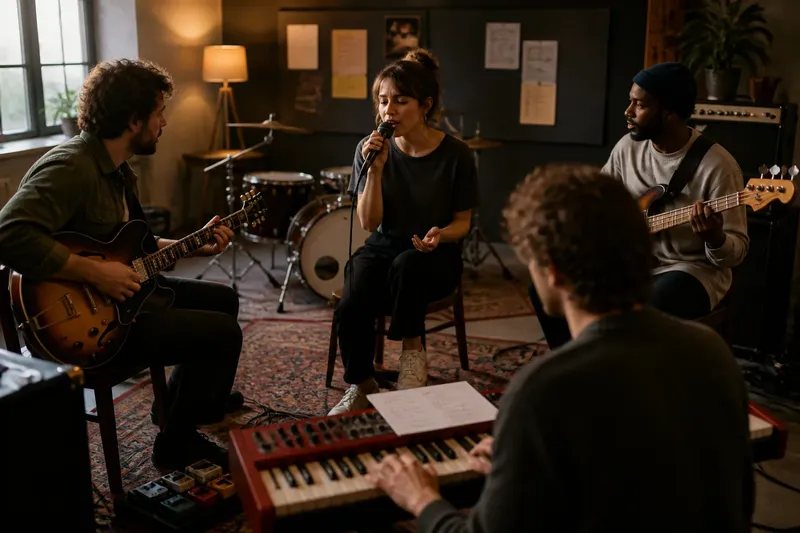
At rehearsal, the singer finishes a line and the guitar, bass and keyboard all answer at once. The room gets louder, but the song’s shape gets harder to follow. Leaving room in a band begins with a small arranging decision: let some parts stop, so the sound that remains can carry the moment.
This is not simply playing softly, nor is it a rule that every instrument needs a turn. It is a way to decide what the listener should notice, and when. A useful plan can unfold across a week: listen for crowded moments, sketch alternatives, try them with the group and keep only the spaces that make the arrangement clearer.
Choose one crowded moment
Begin with a section the band already knows, such as a verse, a pre-chorus or the passage before the final refrain. Pick one short stretch where several parts seem to make the same point. Don’t start by rewriting the entire song; a small patch makes it easier to hear what has changed.
Listen once without playing. Notice where the vocal consonants disappear, where a lyric lands without room to register, or where a transition feels busy even though each part is individually tidy. These are clues, not proof that a particular instrument is at fault. The crowding may come from overlapping rhythms, a sustained chord under a vocal tail, or several accents arriving together.
Write down what should remain audible at that moment. The answer might be the last word of the line, the bass movement into the next chord, or the drummer’s pickup. Naming one focal detail gives the band a shared reason for reducing parts; “make it less busy” is harder to act on.
Map the existing parts
Make a simple part map on paper. Use one row per instrument and mark only when it plays, sustains, or leaves a rest. It need not capture every note. A rough map can reveal that the keyboard holds through the whole bar while the guitar strums each beat, or that both instruments place an accent beneath the same lyric.
For each instrument, ask what its current contribution is doing. A part may set the pulse, support the harmony, answer the singer, or signal a transition. If two parts perform the same job in the same register, one may be able to rest briefly, change its rhythm, or play a more open voicing. Keep the job in view: reducing notes is useful when it gives a necessary role more definition, not simply because fewer notes sound tasteful.
Consider duration as well as activity. A chord struck at the start of a vocal line may continue to mask the end of it. A player can shorten the sustain, mute cleanly, or leave the next chord to another instrument. In a band, the silence after a sound is part of the arrangement too.
Sketch a week of trials
Keep the experiment modest and spread it over several short sessions. The purpose is to compare clear alternatives while the song stays familiar. If schedules allow only one rehearsal, the same sequence can happen within it, with a brief pause between versions.
- First session: Play the chosen section as it stands, then mark the moments where the focal detail gets obscured. Don’t edit during the first pass; let each player hear the same problem before discussing solutions.
- Second session: Try one change at a time. For instance, have the keyboard hold back during the singer’s final phrase while the guitar keeps its existing figure. Then restore the keyboard and ask a different part to rest instead.
- Third session: Compare the versions at the same tempo and with the same dynamics. Listen for whether the lyric, pulse or transition is easier to follow, and whether the gap feels intentional rather than like someone missed an entrance.
- Fourth session: Play the entire section before and after the edit. A rest that works in isolation may leave the following entrance unsupported, so check the lead-in and the return as well.
- Final session: Agree on the version, mark the rest in each player’s chart, and run it without stopping. If the arrangement still feels unclear, return to the map rather than adding a new layer by instinct.
These sessions do not need to occupy whole evenings. A focused comparison is often more useful than repeatedly playing the song from the top without deciding what to listen for.
Shape the gap together
When one player rests, the others inherit the responsibility of making the space feel musical. That does not mean they should fill it. The bass might sustain a root while the guitar releases its chord; the drummer might leave a cymbal accent out so the vocal tail stays exposed. The right choice depends on the song’s existing pulse and harmony.
Be precise about the length of a rest. A player may stop for the singer’s last two words, leave the whole following beat open, then return on a clear cue. A nod, a breath, a pickup or a written bar line can help the ensemble share that boundary. The cue should be audible or visible without becoming a new performance for its own sake.
Imagine a four-piece band where the guitar and keyboard both play full chords under the last line of a verse. The group marks the singer’s final phrase as the focal point, then tries a version in which the guitar rests after the lyric begins while the keyboard changes to a short chord. The expected observable result is that the words and the chord’s release become easier to distinguish; if the transition loses its pulse, the band can let the bass or a restrained drum pattern carry it instead.
Listen from outside
Players inside a band hear their own instruments most clearly, so rotate the listener’s position. One person can sit across the room while the rest play, then describe what was easy to follow without ranking anyone’s contribution. If a phone recording is useful, place it where the whole group can be heard and use it as a listening aid, not as a verdict on tone.
Listen for the effect of the edit, not for whether the silence sounds impressive. Can the lyric be understood? Does the groove still feel settled? Is the next entrance clear? Does the space give the song a breath, or does it merely expose a gap with no direction? These questions help the band distinguish purposeful absence from an arrangement that has lost its support.
It is not worth debating tiny differences in every chord voicing before the larger overlap is resolved. Nor does every quiet moment need to be filled with a delicate substitute. If a clear rest works, let it stay simple.
When should a part rest?
Should everyone stop at once?
Only if a full-band break serves the song’s phrasing or transition. Often it is clearer for one part to rest while another keeps the pulse or sustains the harmony.
How long should a rest last?
Let the musical event decide: it might be the end of a lyric, a beat, or a whole bar. Mark the return clearly so the space feels chosen rather than uncertain.
What if the silence feels empty?
Check whether the missing part had a necessary role, such as maintaining the pulse or signalling a chord change. Restore that function with the least intrusive part available, rather than bringing every layer back.
Can a player change a part without resting?
Yes. A shorter chord, fewer attacks, a higher register or a simpler voicing can create room while keeping the instrument present. Compare that version with a full rest and choose the one that leaves the focal detail clearest.
Keep the arrangement legible
Once a choice works, record it in the same place each player reads: a rest, a cue, or a brief note such as “hold through vocal tail”. Use ordinary musical notation where the band already uses it. Labels that are clear to one player but vague to another can undo the agreement at the next rehearsal.
For parts involving instrument technique or equipment, follow the maker’s instructions and any relevant local rules. Most arranging decisions here need no special gear: a pencil, a part map and attentive listening are enough.
Leaving room in a band is less about achieving a sparse sound than about making each entrance meaningful. Revisit the marked section after the band has learned it; if a rest has become automatic but no longer helps the song, adjust it. Space is a choice the ensemble can keep shaping, one phrase at a time.